Introduction
For many restaurants, salons, retail stores, professional offices, and other customer-facing businesses, online reviews have become an important part of the way potential customers evaluate a business. A person looking for a restaurant may check Google before deciding where to eat. Someone searching for a salon may compare ratings and customer comments. A shopper may also look at online feedback before visiting a local store.
Because reviews can influence how a business is perceived online, making it easy for customers to find a business’s review page can be useful. One approach is to provide a physical sign at a reception desk, checkout counter, host stand, or other visible location.
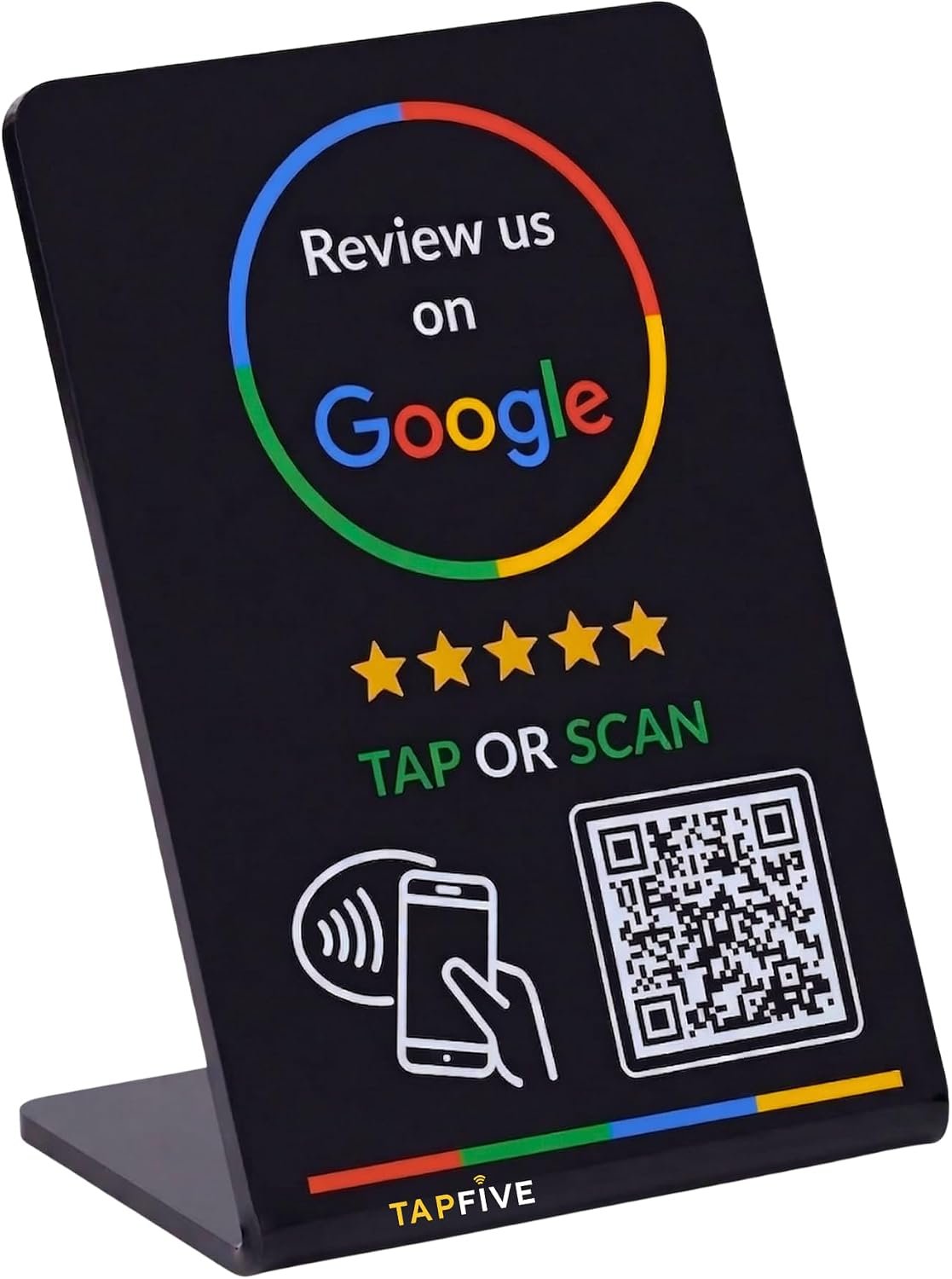
The Google Review Stand by TapFive is designed around this concept. The product combines NFC tap functionality with a QR code in a compact physical stand intended to help customers access a business’s Google review destination. The listed version is black and includes one stand. It is designed for settings such as restaurants, salons, retail businesses, and front desks, where customers are already interacting with staff or completing a transaction.
Rather than treating a review sign as a simple piece of decoration, it is helpful to understand how NFC and QR technology work together, where a review stand can fit into a customer experience, and what practical considerations a business should evaluate before using one.
This guide explores the TapFive Google Review Stand from an informational perspective. It looks at its core features, potential applications, setup considerations, the differences between NFC and QR access, and the factors businesses should consider when deciding whether this type of signage fits their workflow.
What Is a Google Review Stand?
A Google review stand is a physical sign or countertop display that gives customers a convenient way to access a business’s online review page.
Traditionally, businesses might ask customers verbally to search for the company on Google. While this can work, it requires the customer to remember the business name, open a search engine, identify the correct listing, and then locate the review option.
A physical review stand can simplify that process by placing an access point directly where the customer is already present.
The TapFive stand uses two common technologies:
- NFC, which allows compatible smartphones to interact with the stand through a tap
- A QR code, which customers can scan using a smartphone camera
These two methods provide different ways of reaching the intended digital destination.
The combination can be particularly useful because smartphones differ in how users prefer to interact with physical signs. Some people are comfortable tapping their phone against an NFC-enabled sign, while others are more familiar with scanning a QR code.
Key Features of the TapFive Google Review Stand
NFC Tap Functionality
One of the defining features of the TapFive stand is its NFC functionality.
NFC, or Near Field Communication, is a short-range wireless technology that allows compatible devices to exchange information when they are brought close together. It is commonly used for contactless payments, digital access systems, transportation cards, and other proximity-based interactions.
In the context of a review stand, NFC can provide a simple interaction. A customer with a compatible smartphone can bring the device close to the designated NFC area, potentially triggering the associated digital destination.
The main advantage of NFC in this setting is convenience. Instead of opening a camera application and positioning the phone over a QR code, the customer can use a proximity-based interaction.
The exact behavior can depend on the smartphone, operating system, browser settings, and the way the NFC destination has been configured.
QR Code Access
The second major component is the QR code.
QR codes are two-dimensional barcodes that smartphones can recognize through their cameras. They are widely used in restaurants, retail environments, packaging, advertisements, menus, event signage, and business cards.
For a review stand, a QR code can serve as a visual alternative to NFC.
A customer can open the smartphone camera, point it toward the code, and follow the displayed link. This can be helpful for people who are unfamiliar with NFC or whose device does not support the necessary NFC functionality.
Having both methods available gives the physical stand greater flexibility than relying on a single interaction method.
Compact Countertop Format
The product is designed as a stand rather than a large wall-mounted sign.
This format can be useful for businesses that have customer interaction points such as:
- Reception counters
- Checkout desks
- Restaurant host stands
- Salon reception areas
- Hotel front desks
- Service counters
- Retail checkout areas
- Waiting areas
A countertop format also makes it possible to move the sign between locations when necessary.
For example, a business could position it near a checkout area during normal operations and move it to a reception desk when the workflow changes.
Black Finish
The listed version uses a black finish.
From a practical design perspective, a neutral color can work with a variety of interior styles. Restaurants, salons, offices, and retail environments often use different branding systems, so a simple black stand may be easier to integrate into an existing counter or reception area than a highly decorative sign.
The visual appearance is still a secondary consideration compared with whether the QR code and NFC interaction are clearly accessible.
One-Stand Configuration
This listing includes one stand.
A single stand may be appropriate for a small business with one primary customer interaction point. Businesses with several locations or multiple independent checkout or reception areas may need to consider whether one physical sign is sufficient for their workflow.
For example, a restaurant with one host desk might only need one visible location, while a larger retail environment could have several customer service points.
How NFC and QR Codes Work Together
The combination of NFC and QR technology is one of the more interesting aspects of this type of product.
Although both methods can lead a customer toward the same digital destination, they work differently.
NFC Interaction
NFC works through short-range communication between a compatible device and an NFC-enabled object.
The user typically brings the phone close to the relevant area of the stand. If the device and configuration support the interaction, the phone can recognize the NFC information and provide an option to open the associated destination.
This can create a quick interaction because it does not require manually typing a web address.
QR Code Interaction
QR codes use visual recognition rather than wireless communication.
The customer points a compatible smartphone camera at the code. The phone recognizes the pattern and normally presents an option to open the linked destination.
QR codes have the advantage of being visually obvious. Customers can immediately understand that the square graphic is intended to be scanned.
Why Offer Both?
Providing both methods can reduce dependence on a single technology.
Some customers may already understand NFC and prefer tapping their phone. Others may instinctively reach for the camera when they see a QR code.
The two options can therefore complement one another.
For businesses, this is less about choosing one technology as universally superior and more about providing customers with multiple convenient paths.
How It Can Be Used in Restaurants
Restaurants are one of the most natural environments for a physical review sign because customers frequently complete a defined interaction before leaving.
A stand could potentially be positioned near the host desk, cashier, reception counter, or another appropriate location.
For example, after a customer finishes a meal, staff may already have a natural opportunity to thank them for visiting. A review sign placed nearby can make the business’s online review destination more accessible to customers who independently decide they want to leave feedback.
The important distinction is that the sign should function as an invitation rather than pressure.
Restaurants can also consider visibility. A stand hidden behind equipment or placed in an area customers rarely see may not serve much purpose. On the other hand, positioning it where customers naturally pause can make the technology easier to discover.
The right placement depends on the restaurant’s layout and customer flow.
How It Can Be Used in Salons and Beauty Businesses
Salons often have a reception desk where customers check in, pay, schedule appointments, or speak with staff.
A review stand can fit naturally into that environment.
It could be positioned on a reception counter where customers can see it while completing their visit. The NFC and QR options can then provide a convenient route to the business’s online review destination.
Salons may also have waiting areas, although placement should not interfere with appointment scheduling, payment processing, or customer privacy.
As with restaurants, the most useful approach is generally to make the option available without making customers feel obligated to participate.
How It Can Be Used in Retail Stores
Retail businesses have several possible locations for a review sign.
A checkout counter is an obvious example, but the appropriate location depends on store layout.
A small business could place the stand at the main checkout desk. A specialty retailer might position it near customer service. A showroom could place one near the reception or information desk.
The physical nature of the stand can make it easier to integrate into an existing point-of-sale environment than a temporary piece of paper or handwritten sign.
However, businesses should ensure the sign does not obstruct payment terminals, receipts, product displays, or other important customer-service equipment.
Front Desk and Reception Applications
Hotels, offices, clinics, service businesses, and other organizations may use reception desks as an important customer interaction point.
A review stand can be positioned where visitors naturally wait or complete a transaction.
For businesses that receive customers throughout the day, this can create a consistent location for the digital review access point.
The main consideration is workflow. Reception staff should not need to interrupt their normal duties to explain complicated instructions. The value of a QR and NFC sign comes partly from its ability to provide a relatively self-directed interaction.
Who May Find This Type of Product Useful?
Small Local Businesses
Small businesses often rely heavily on local search visibility.
A physical review sign may provide a simple way to connect an in-person customer experience with an online review page.
This can be particularly relevant for businesses that operate from a single location and have a clear customer checkout or reception point.
Restaurants and Cafés
Food-service businesses regularly interact with customers face-to-face, making countertop signage a potentially natural addition to the customer journey.
The stand may be suitable for restaurants, cafés, bakeries, and similar establishments where customers spend time at a defined location.
Salons and Personal Services
Salons, barbershops, spas, and other appointment-based businesses can potentially place the stand at reception.
Because customers generally interact with staff before leaving, the review stand can become part of the physical environment without requiring a separate digital campaign.
Retail Businesses
Small retailers and specialty stores can use countertop signage to provide an easy path to their online presence.
The usefulness will depend on customer traffic, store layout, and how often customers naturally interact with the selected location.
Offices and Service Counters
Professional offices and service businesses can also consider this type of signage where customer feedback is relevant and appropriate.
Examples might include local service providers, reception-based businesses, studios, and customer-facing offices.
Important Things to Consider Before Using a Review Stand
Verify the Destination
One of the most important considerations is making sure the QR code and NFC destination lead to the intended business location.
A business may have multiple Google profiles, locations, or online pages. Sending customers to the wrong listing can create confusion.
Before putting the stand into regular use, it is sensible to test the interaction using multiple compatible smartphones.
Test Both NFC and QR Functions
The two technologies should be tested separately.
A business should verify that:
- The QR code can be scanned.
- The resulting destination is correct.
- The NFC interaction behaves as expected on compatible devices.
- The destination works on commonly used mobile browsers.
- The sign is positioned so customers can easily access it.
Testing is especially important after any changes to the business’s online presence.
Consider Smartphone Differences
Not every customer uses the same smartphone model or operating system.
NFC behavior can vary between devices, and some users may not be familiar with tap-to-open interactions.
This is one reason the QR code can be a useful complementary option.
A visible QR code gives customers a recognizable alternative if NFC does not work as expected for their particular device.
Think About Placement
Placement can have a significant effect on usability.
A review stand should ideally be easy to see without obstructing important equipment.
Potential locations include:
- Checkout counters
- Reception desks
- Host stands
- Customer service counters
- Waiting areas
- Information desks
The best location is usually somewhere customers naturally pause.
Keep the Area Unobstructed
A QR code needs to remain visually accessible.
If receipts, menus, paperwork, promotional materials, or other objects regularly cover part of the sign, customers may not be able to scan it easily.
Similarly, the NFC area should remain accessible rather than being surrounded by objects that make tapping awkward.
Consider Customer Experience
A review request is part of the overall customer experience.
Businesses should avoid turning the sign into a source of pressure. Customers should be free to decide whether they want to leave feedback.
The goal of a review stand is convenience, not coercion.
Review Requests and Platform Policies
Businesses should also be aware that review platforms have their own policies governing how reviews may be requested.
A physical sign can provide access to a review page, but businesses should avoid using it to manipulate the nature of customer feedback.
For example, a business should be careful about practices that attempt to selectively encourage only positive reviews while discouraging negative feedback.
The safest approach is to provide a neutral opportunity for customers to share their genuine experience.
This distinction is important because the purpose of review technology should be to make the feedback process easier, not to manufacture a particular outcome.
NFC Versus QR Codes: Understanding the Difference
Businesses considering digital review signage may encounter several categories of products.
QR-Only Signs
QR-only signs are generally straightforward. Customers scan a visual code with their smartphone camera.
Their main strength is familiarity. QR codes are now common in many everyday environments.
The limitation is that the customer must physically position the camera correctly and interact with the scanning interface.
NFC-Only Signs
NFC-only solutions focus on proximity-based interaction.
They can provide a convenient experience for compatible devices, but customers unfamiliar with NFC may not immediately understand what to do.
Device compatibility can also be an important consideration.
Combined NFC and QR Signs
A combined product provides both interaction methods.
This can make sense for businesses that want to accommodate different customer preferences without placing separate signs on the counter.
The TapFive stand falls into this combined category, providing a physical stand with both NFC and QR access.
Printed Review Cards
Businesses can also use conventional printed cards.
These may contain a QR code, a web address, or instructions for finding the business online.
Printed cards can be inexpensive and easy to distribute, but they can also be easier to lose or overlook.
A countertop stand has the advantage of remaining in a designated physical location.
Practical Ways to Integrate the Stand Into a Business Workflow
A review stand does not necessarily need to be treated as a separate marketing campaign.
It can simply become part of the existing customer environment.
For example, a restaurant could place it near the host station. A salon could position it at reception. A retail store could keep it near the checkout counter.
The key is consistency.
If the stand is moved frequently, customers and staff may not know where to find it. If it remains in a predictable location, employees can easily direct customers toward it when appropriate.
Another useful consideration is staff training. Employees do not necessarily need a detailed technical explanation of NFC. They simply need to understand what the sign is for and how customers can interact with it.
Maintaining a Professional Appearance
Even a technically useful sign can become less effective if the surrounding area looks cluttered.
A review stand works best when it fits naturally into the environment.
Businesses can consider keeping the surrounding countertop organized and ensuring the sign remains upright and visible.
For restaurants and salons in particular, the physical appearance of the customer-facing environment can contribute to the overall impression of the business.
A simple black stand may therefore be easier to incorporate into a variety of interior styles than highly promotional signage.
Frequently Asked Questions
What is the TapFive Google Review Stand?
The TapFive Google Review Stand is a physical countertop sign designed to provide customers with access to a business’s Google review destination using NFC tap functionality and a QR code.
Does the stand require customers to use NFC?
No. The product combines NFC and QR access, allowing customers to use the method that is appropriate for their smartphone and preferences.
What is NFC?
NFC stands for Near Field Communication. It is a short-range wireless technology that allows compatible devices to communicate when they are brought close together.
What is the purpose of the QR code?
The QR code provides a visual scanning option. Customers can use a compatible smartphone camera to scan the code and follow the resulting link.
Can this type of stand be used in a restaurant?
Yes. A restaurant can potentially use a review stand at an appropriate customer interaction point, such as a host desk or checkout counter.
Could a salon use the stand?
A salon may place it at reception or another suitable customer-facing area. The exact placement depends on the salon’s layout and workflow.
Is it suitable for retail businesses?
It can be considered for retail environments, particularly at checkout or customer service counters where customers naturally interact with staff.
Does every smartphone support NFC in the same way?
No. NFC functionality and behavior can vary depending on the smartphone, operating system, settings, and other technical factors. This is one reason having a QR code available can be useful.
Should a business test the stand before using it?
Yes. Testing the QR code and NFC functionality with multiple compatible devices can help identify potential problems before customers encounter them.
Where should a review stand be placed?
Common locations include reception desks, checkout counters, restaurant host stands, customer service desks, and other areas where customers naturally pause.
Does having a review stand guarantee more reviews?
No. A physical sign can make the review destination easier to access, but it cannot guarantee that customers will leave reviews. Customer satisfaction, willingness to provide feedback, visibility, and many other factors influence review activity.
Can a business require customers to leave a review?
A business should treat review requests carefully and respect applicable platform policies. A review sign is best used as an optional way for customers to access the review process rather than as a requirement.
Is a QR code still useful if NFC is available?
Yes. QR codes provide a familiar alternative for customers who prefer scanning or whose devices do not interact with NFC in the expected way.
Is one stand enough for every business?
It depends on the business. A small business with one primary reception or checkout area may find one stand sufficient, while businesses with multiple locations or customer service points may have different signage needs.
Conclusion
The TapFive Google Review Stand represents a simple connection between a physical customer environment and a digital review destination. By combining NFC tap technology with a QR code, the stand provides two different ways for customers to access the relevant online page using a smartphone.
Its countertop format makes it potentially useful in a variety of settings, including restaurants, salons, retail stores, reception areas, and other customer-facing businesses. The black finish can also fit naturally into many professional environments without requiring elaborate signage.
The most important considerations are not simply the presence of NFC or a QR code. Businesses should verify that the digital destination is correct, test the interaction across different devices, choose an appropriate location, and make the review process optional and straightforward for customers.
A physical review stand cannot replace good service or guarantee customer feedback. Its role is more practical: it can reduce the steps required for customers who already want to share their experience.
For businesses considering NFC and QR-based review signage, understanding these practical details can make it easier to determine whether a countertop solution fits their customer journey and day-to-day operations.
Leave a Reply